One Point Perspective


What I drew is a room in one point perspective. In this room I have a bed, a door, a window, a table with a lamp, a Star Wars poster, and a rug. I learned that in one point perspective you have to pay attention to where you draw every single line.  I am most proud of the bed I drew. It looks the best and it took the most time. I would want to improve in my Star Wars poster. One tip for next year is to pay attention to the dot in the middle and follow each line.
IMG_0113
IMG_0113

One Point Perspective

In my room there is a bed(to the right). there is also a TV on a table right under a window. In the room there is also a door and a skylight. I have a tile ceiling and wood floors. One point perspective is really easy if you know how to do it. In this room I'm most proud of the ceiling and the posters. I wish I could improve on the table and add more detail to the wood floors. If your doing a one point perspective drawing you should follow the directions carefully. if you mess up in the first few steps the drawing wont look right.
IMG_2316 (2)
IMG_2316 (2)

One Point Perspective

​My room has door, Windows, T.V., Bed, carpet and drawing broad. I learned that you draw your room by a vertical point or like how you see your room. The most thing I am proud of that I draw the whole room and I tried hard. I need to improve the details in my room because I did not draw them good. I would give them a tip that draw your room of what you see and try your best.
IMG-5809 (1)
IMG-5809 (1)

One point perspective room

The room I drew is very minimalist and simple. It contains a bed, built in bookshelf, a flower poster, a rug, a dresser, an Alexa, a floor lamp, a window with curtains, a door, and a pillow. That the vanishing point really makes a difference in drawing something realistically. I am most proud of the rug and the wooden floors because that was the most time consuming. I would work on my neatness and add more decoration. Don't rush and be precise. Use all of the available time you get
IMG_5659
IMG_5659

One Point Perspective Room

I drew a pretty simple room with a table and chair. There is also a balcony on the left. While I am proud of the balcony since I had to figure out how to draw it without the help of a lesson in class, it is also the part of the drawing with the most room for improvement. It isn't quite at the right angle and I realized after finishing the drawing that the wall probably should have been parallel with the bottom of the paper. While doing this project I leaned that the most important thing is to always bring lines exactly to the vanishing point. Sometimes when drawing a window it will at first seem that it would look better if the lines were at a different angle but it is best to draw the line to the vanishing point anyway as the finished product will look good. That said, my main piece of advice for anybody doing a one point perspective drawing is to make sure to always use a ruler. If you think you can do it free hand, it will end up looking really messy. 
20180604_090829
20180604_090829

One Point Perspective Room

The room I drew is a one point perspective room with a window, a door, a bed, a table, three pictures, and a skylight with stars all around the walls with my name on one. I learn that when you draw a one point perspective drawing you have to have a rule and a vanishing point. All yours lines must go back to the vanishing point. I am most proud of that I was able to draw a room that looks real. I wish that I could get rid of some of the erasing marks. One tip is make sure your drawings goes back to the vanishing point and use a ruler.  
IMG_2875 (1)
IMG_2875 (1)

One point perspective room

the room i drew is a combination of a dinning room and living room. There is a chair, table, t.v, poster, window, t.v stand, door, and tiled window. I've learned that one perspective is hard to do. I'm most proud of the poster i drew. i wish i could improve everything about my room. One tip for someone doing this project next year is don't be too lazy with the project.
20180604_084147
20180604_084147

One Point Perspective room

The room that I drew has a tv, two pictures, a table, vase, chair and a bed.  I learned that in order to make something 3D you need to make it go back to the vanishing point. I am really proud on how the ceiling turned out and the floor. I could have improved the bed to make it a little neater and maybe a little bigger. One tip I would say is make sure that you use a ruler in order to make it look neat and perfect. 
IMG_3063
IMG_3063

One Point Perspective

In my room I have a skylight, window, door, carpet, a bed, a table, and a art picture. I learned that the vanishing point is the place where the viewer is is looking. I am proud of my wooden tiles that I did. I wish I could improve on the details of my room.  One tip for someone doing this project next year is to try super hard.
IMG_2113
IMG_2113

One Perspective Room

I drew what could be an art room. Im not sure what i meant this room to be but it has a window seat and a table in it. There's a carpet and two large windows. The back wall is decorated in vines and pictures and there is a sign on the door that says "Alice's Wonderland". While drawing my room I learned that almost all line in tour drawing should go back to the vanishing point. It helps keep your room together and it helps it look realistic. The thing I'm most proud of in my room is the carpet. I think its the most detailed thing in the room. Although I like it the best if i had to change something about the project it would be that. I don't think it fits in the room well. For anyone else doing this project, i think that you should practice doing things in one point perspective. You're going to erase a lot and be really confused if you don't practice at least a little first.
Snapchat-924708133
Snapchat-924708133

One Point Perspective Room

My room has a wood floor and two doors. It has a skylight and three windows. The furniture includes a bed, a table, and a rug. There is also a tv, a sign, and a clock. I drew what could be a bedroom because there's a bed in it.
I have learned that one point perspective always has to have a vanishing point because everything goes back to that and the is one of the major foundations of the drawing. I have also learned that a horizon line helps give the drawing more details.
I am most proud of how I applied what we learned about vanishing points in my drawing. This helped me create a room that actually looks like you are looking straight at it and drawing it with detail. I am also proud of my furniture because it actually looks good. 
I wish that I could have drawn some of the personal drawings a little better because I couldn't figure out what to actually draw. I also wish that I could have added more specific details.
One tip that I would give is to take your time because if you rush, then your drawing will not have the effect of one point perspective. 
IMG_2158
IMG_2158

One Point Perspective Room

The room I drew is a simple bedroom with a table, TV, and bed with two skylights. Also a small light controled by a dimmer lightswitch. I learned that one point perspective can really help with drawing real thing based on the room's size and shape. I am most proud the grass outside as it hurt my hand doing each blade and making value by dding more. I wish I could improve the details in my piece to make it more relistic. Take advantage of the vanishing anywhere possible as it really helps you make everything fit in the rooom. 
20180604_083923-1
20180604_083923-1

Fast Plants Reflection

f1 generation (2.4.18)
f2 generation (4.12.18)
Did the F2 generation look like how you predicted them to look?

The f2 generation didn’t look like how I expected them. I thought my plants would be a lot smaller than the f1 generation. When I checked the plants, they seemed taller than the first ones. I did expect the colors to be the same since we basically planted the same seeds the first and second time.

Did the parent generation or the F2 generation grow faster? 

The f2 generation did grow faster than the first. With the first generation, it took about a week until I seen some sprouts growing. I planted the f2 generation and within a couple days, sprouts were growing in the soil.


What might have hindered your plants' ability to thrive?

I think some abiotic and biotic factors could have hindered the plants. Some abiotic factors would be the air and water. The air would sometimes be hot and cold. At times, I believe we watering a little too much. Some biotic factors could be the surrounding plants a. The surrounding plants would grow very close to ours.

How do genetics and the environment affect the phenotype of an organism? 

The genetics affect the phenotype by having different mother plants and father plants. So if two of the same exact plants mate, their offspring would be the same as well. But if the mom plant was heterozygous and the dad plant was homozygous, then their offspring would be different. The environment could affect the phenotype because of the location of where the plants are and the temperature in the air.

Which is a greater indicator of how an organism will look?

A greater indicator would have to be the phenotype and genotypes of the parents. The genes of the parent will assist in the making of the plant’s genes. Also, the parents’ phenotypes will help with the offsprings’ phenotypes. Meaning the phenotypes could be mixed or one phenotype only from one parent.

A summary of what stood out to you during this course and why. 

During the fast plants, I would say what stood out to me is the actual plants growing. When I was young, I would plant plants but they wouldn’t grow to their full potential. They would have a few sprouts until they died. Even when I did what I was supposed to with the plants. Another thing that stood out to me was the seeds inside of the f1 and f2 generation. I’m being completely honest, I didn’t think plants could have babies. So when I saw the seeds from the plants, I was surprised. The fast plants' mini project was fun to do and to actually have plants grow.

Fast Plants Final Reflection

AC3B7E5C-2C34-4955-BA55-9C66089916C4
During this past semester we have been observing our Fast Plants and also their offsprings F1 and F2. So,  during this process our F2 generation didn’t grow but, the parents did actually grow which is great but, they didn’t get far which is sad but, because of our ability to take care of them. Genetics and the environment affects the phenotype of an organism by building and manipulating it’s structure.The Genetics and environment is the greater indicator of how an organism will look because it’s makes up the Phenotype which makes the organism physical features. Nothing stood out to me because our plants kept dying.
 

https://www.sciencelearn.org.nz/resources/207-genotype-and-phenotype https://www.livescience.com/43560-plant-science-for-kids.html

Fast Plants Final Reflection

Screenshot 2018-06-03 at 21.10.23
  1. Did the F2 generation look like how you predicted them to look?

The F2 didn’t look how I predicted, I figured the F1 would be the smaller generation but they were in fact larger than the F2. My colors were the same for all of the seeds while I expected them to be different shades.

  1. Did the parent generation or the F2 generation grow faster?

The F2 generation grew faster than the others, the first generation barely grew at all but the F2 grew quick.

  1. What might have hindered your plants' ability to thrive?

What hindered my ability to thrive was the lack of constant care we showed our plants and the general there isn’t a guarantee concept. Maybe it didn’t have enough air or was pushed off the white blanket a couple times so it didn’t receive much water. Other  plants grew very close so maybe some domination occurred.


  1. How do genetics and the environment affect the phenotype of an organism?

The genetics affect the phenotype by having different parent plants. If one is heterozygous and one  homozygous, the offspring will be different. If the environment isn’t up to par this can too affect the outcome of the plant.

5. Which is a greater indicator of how an organism will look?

It will depend on the parents of the plant.

6. A summary of what stood out to you during this course and why.

What stood out to me was how the plants were dying once they were pregnant because I thought they’d need to stay alive to nourish their offspring but they actually die like a lot of insects do. I’ve never had to grow a plant but I’ve had my dad buy me flowers, I see that you have to give them exactly what you did in the beginning in order for them to survive the way you have to do anything in life or it will die.


Fast Plants

Dexter Le

6/1/18

Biochemistry 2


Fast Plants Final Reflection


Throughout this semester, I have been observing the plants that our group planted in order to test Mendel’s theory of genetics and inheritance. We had observed two generations of plants, the F1 generation and the F2 generation. For our F1 generation, we had selected the seeds with the “Non-Purple Stem” and “Standard Purple Stem Hairy” traits. These plants would cross-pollinate and create seed pods which would serve as the primary seeds for the F2 generation.


There are also many variables that can play into the effect of each generation’s development such as the nursery and water. The growth of the plant can be severely affected by the environment. According to the United Kingdom Cannabis Social Clubs, the author states, “For plants to photosynthesis and grow they need constant air exchange to refresh the CO2 content of the surrounding air during both day and night periods”. In addition, water is a vital component to plants. Without water, the plants would not be able perform photosynthesis. These challenges affect the plant’s possible phenotypes. When I started analyzing the plant pictures, I have noticed that the development of the F2 generation was very similar to the F1 generation. A similarity was the the developing leaves of the F2 generation. Although the F2 generation did not have as many leaves in comparison to the F1 generation, the first weeks were very similar to the past generation. The parent generation grew faster whereas the F2 generation took some time in order to fully develop. I believe that the slow development of the F2 generation could possibly be the environment changes taking place outside. During the development of the parent generation, we were still going through Winter. Whereas, the F2 generation started development in late Winter and throughout Spring. In addition, the F2 generation was in development through an abnormally cold Spring which I believe could have played an effect on the growth of the generation.


Although in appearance, it seems as if some of the leaves in the F2 generation have different colors and patterns in comparison to the parent generation. We predicted that the F2 generation would have minor differences in comparison to the parent generation. Our prediction was correct because we have noticed colors that have been mixed with the F2 plants from the parent generation. The shape of the plants in the F2 generation resemble the parent generation almost exactly. After observing the pictures over and over, I have realized that the greatest indicator that determines the future of the plant’s appearance would have to be through development. In the F1 generation, you can see mini leaves growing during development. However, at maturity, the plant has retained the same color. This same indicator has also occurred on the F2 generation. At development, it is easy to determine the appearance of the plant as the leaves would grow and retain the color.


In conclusion, the observation of these plants have been fascinating. What stood out from this experiment the most was how Mendel’s Genetic Inheritance theory could visually be seen throughout the experiment. After doing research, I found an article that stated, “ A closer look into the inside of the [plant] cell, however, will show you that the way that genes and chromosomes work is extremely similar in all living things”. This experiment made me realize how similar we are to plants. Offsprings are able to inherit genotypes from their parents which makes them unique. After observing the plants throughout this semester, it was very enlightening seeing the similar characteristics.

Sources:
"Indoor Gardening: How Important Is Airflow And Exchange?." UKCSC. N.p., 2018. Web. 3 June 2018.
"Mendel's Plants | Ask A Biologist." Askabiologist.asu.edu. N.p., 2018. Web. 3 June 2018.

Parent Generation Development
Parent Generation Maturity
F2 Generation Development
F2 Generation Growth

Fast Plants Journey !!!

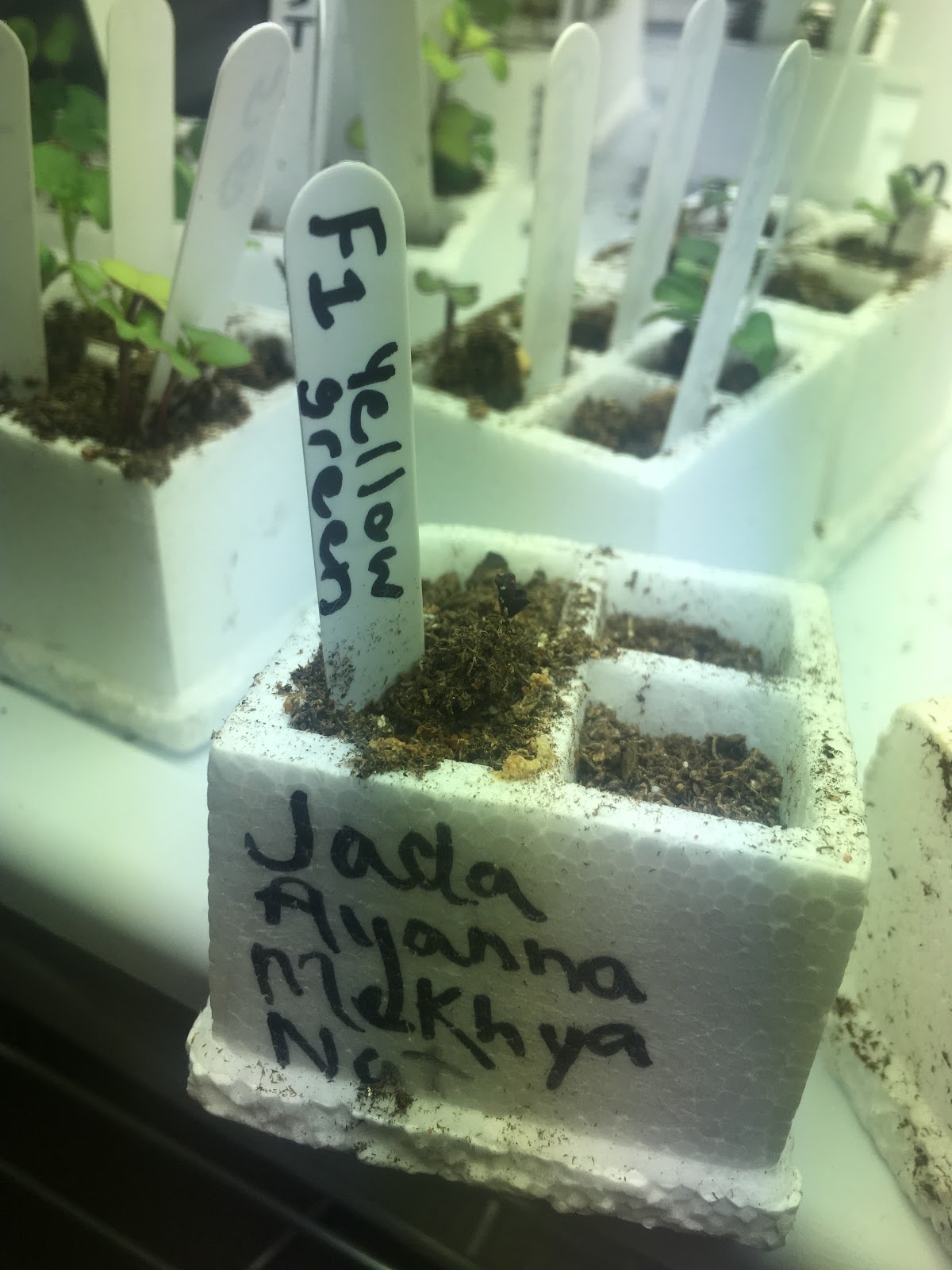
During this Last semester in Biochem 2. We have been observing fast plants (F1) and their fast plant offspring (F2). At the beginning of this semester, we grew 5 types of fast plants provided by Ms.Aziz.My group chooses to have : (ST)Standard Purple Stem Hairy, (NP)Non-Purple Stem, (YG)Yellow-Green Leaf, and (NG)Non-Purple stem yellow-green leaf with our surprise plant Type “B” that’s purple and green. These plants took about 3 weeks to grow before they were ready to be pollinated. Once they were all pollinated with the “B’ seed, they sprouted about 2 and a half months after. The F2 plants were not successful, because we didn’t look after them as much. Only 2 of the 4 plots had seedling germination, but it didn’t last more than two weeks before it shriveled up and died. Though before they died we saw that the sprout was a purple steam, which came from the B F1 plant.

In this mini project, we found that the F1 plants grew a lot faster than the F2 plants and that they were all able to reproduce a small amount. Some of the factors that could have hindered our F2 plant growth might be water consumption. One reason for this could have been because every time we check the plant it would be dry so we would add extra water. In the parent plant, each plot was moist and rarely dry, but in the F2 plants, the plots were almost always dry. Another factor that could have affected how they grow could have been the amount of light they received. The F1 plants were under the constant light while the F2 plants had a timer that only gave them about 6-7 hours of light each day.

Something that stood out to me in this mini-project was my ability to nature and care for the F1 plants. This is because the F1 plants were able to survive long enough to reproduce and make the second generation. Even with the F1 plants turning out good in every way, I realized that this is always not the case. With the F2 plants, you see that it was not the same and that it was only half the success. As you continue to plant seeds from each generation the outcome will be different/varied.

Q4 Final Project

The image is a self portrait of me showing my emotions on the outside. It shows how tired and drained I am and how sad I be from working long hours at work and going to school. I want my work to communicate the fact that you should take care of yourself and be good on the inside so it won’t show on the outside. For my image I used soft pastels. I wanted everything to look soft as if it would melt if you touch it. This relates to my previous work because my previous work is mostly self-portraits. The process to create was I first did a sketch and then i start on the big areas and shaded the color in then I went in on the little details and then I added anything to it that would make it pop. An artist that has work similar to mine is Frida Kahlo. She makes mostly self portraits that correlate to her personal life. A technique that was important to creating my image was to make sure I put a paper over my work so it doesn’t smudge. A new technique I learned was to rub in the colors with your finger to make it blend better. I am most proud of the fact that I was able to create a product that I imagined in my head. One thing I would change about this is the fact that the canvas I made it on was very small and not able to really showcase my work. Throughout this project I learned how to mix colors very well and I learned how to use soft pastels.
SianniWood
SianniWood